Introduction
Interest in psilocybin mushrooms has grown significantly in recent years as scientific research has explored their potential effects on mental health, cognition, and perception. While media attention often focuses on remarkable research findings or personal stories, one factor consistently receives less attention than it deserves: preparation.
No mushroom variety, dosage guide, or online recommendation can replace careful self-assessment. Before considering a psychedelic experience, taking time to evaluate your circumstances can help you make a more informed decision and reduce avoidable risks.
This guide explores ten practical questions that encourage thoughtful preparation. These questions are not about persuading anyone to use psilocybin. Instead, they are designed to help adults make safer, more responsible decisions where use is legally permitted.
Legal Notice: Psilocybin mushrooms remain illegal in many countries. Always understand the laws where you live before purchasing or possessing psychedelic substances.
1. Am I Making This Decision For The Right Reasons?
Every decision begins with motivation.
Some people are genuinely interested in learning about consciousness.
Others are curious after reading scientific research.
Some hope mushrooms will immediately solve long-standing personal problems.
These motivations are very different.
Psilocybin is not a guaranteed solution for stress, anxiety, depression, or relationship difficulties. Clinical studies investigating these areas occur under carefully controlled conditions with trained professionals—not through casual or unsupervised use.
Before moving forward, ask yourself whether your decision comes from informed curiosity or unrealistic expectations.
2. Have I Learned From Reliable Sources Instead Of Social Media?
The internet contains thousands of personal trip reports, but personal experiences are not scientific evidence.
Instead of relying solely on videos or anonymous online discussions, spend time reading educational resources produced by respected research institutions.
For example, the Johns Hopkins Center for Psychedelic and Consciousness Research explains ongoing clinical research into psilocybin, while the National Institute on Drug Abuse (NIDA) provides balanced information about psychedelic substances, potential risks, and current scientific understanding.
Building knowledge first often leads to better decisions later.
3. Is My Mental Wellbeing Stable Right Now?
Psychedelics may temporarily intensify emotions and patterns of thinking.
That means today’s emotional state can influence tomorrow’s experience.
If you’re currently dealing with severe anxiety, unresolved trauma, panic attacks, or major emotional distress, postponing may be the safest choice.
Many experienced harm-reduction educators encourage waiting until life feels relatively stable before considering a psychedelic experience.
Preparation includes knowing when not to proceed.
4. Have I Considered My Physical Health?
Preparation isn’t only psychological.
Simple factors such as dehydration, poor sleep, illness, or exhaustion can affect how comfortable you feel throughout the experience.
It’s also important to consider prescription medications.
Certain antidepressants and psychiatric medications may change how psilocybin affects the body or brain.
Never stop prescribed medication without guidance from a qualified healthcare professional.
5. Does My Environment Encourage Relaxation?
Your surroundings become part of the experience.
Rather than choosing somewhere exciting or unpredictable, many experienced users recommend selecting an environment that feels familiar and comfortable.
Helpful features often include:
- Comfortable seating
- Easy access to drinking water
- Soft lighting
- Minimal interruptions
- Pleasant temperature
- Calm music if desired
- Easy access to a bathroom
Reducing unnecessary stress allows you to focus on the experience rather than external distractions.
6. Have I Planned The Practical Details?
People frequently spend hours comparing mushroom varieties while forgetting basic planning.
Consider practical questions such as:
- Who knows where I am?
- Is my phone charged?
- Do I have water available?
- Have I finished important responsibilities?
- Will I need to drive later?
Responsible planning extends beyond the mushrooms themselves.
Removing avoidable worries beforehand often creates a calmer experience.
7. Do I Understand That Potency Can Vary?
One common misconception is that every mushroom produces identical effects.
In reality, potency differs between species, individual harvests, growing conditions, and storage methods.
Because of this variability, estimating dosage by appearance alone is unreliable.
Accurate measurement using a digital scale is considerably safer than guessing.
If you’re still researching responsible preparation, our Magic Mushroom Safety Guide provides additional educational information about preparation, storage, and general harm-reduction principles:
Magic Mushroom Safety Guide
8. Have I Thought About What Happens Afterward?
Many people focus entirely on the experience itself.
The hours and days afterward deserve equal attention.
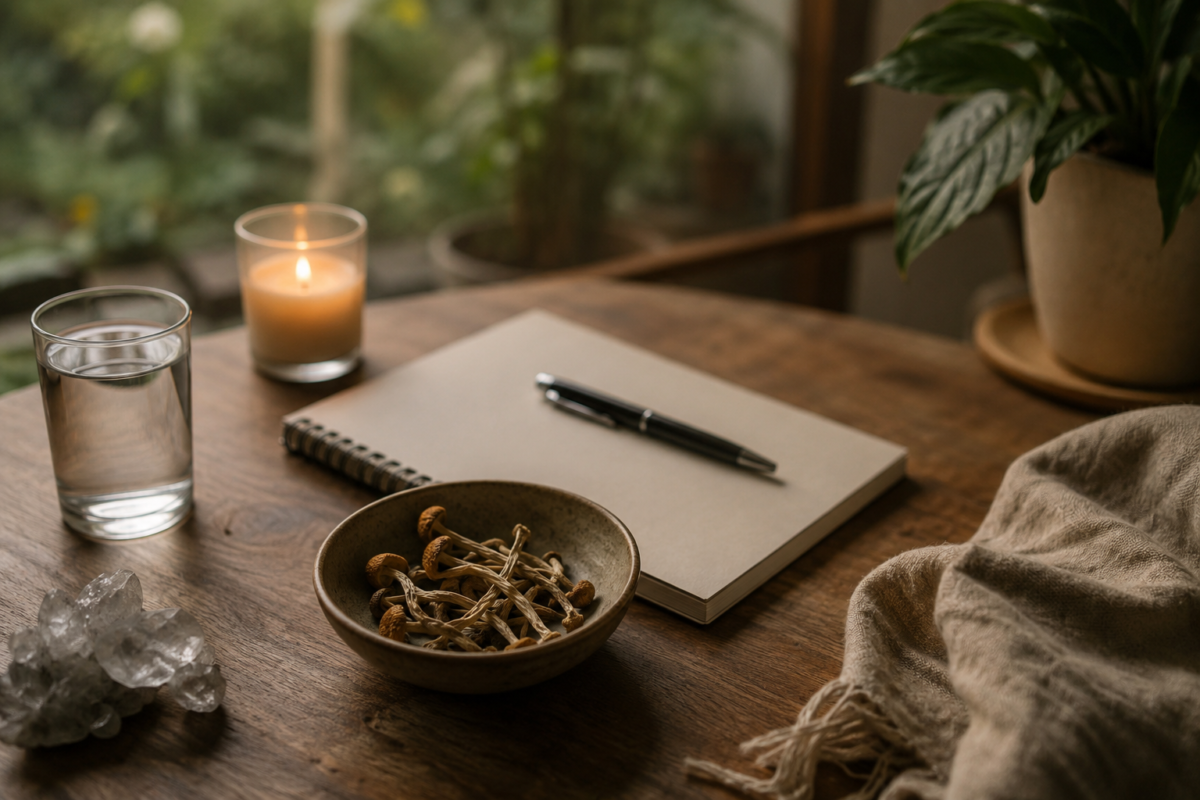
Some individuals enjoy writing notes about what they experienced.
Others spend time walking outdoors, discussing their thoughts with trusted friends, or simply resting.
Reflection helps distinguish temporary impressions from meaningful personal insights.
Planning time for recovery demonstrates the same level of responsibility as planning the experience itself.
9. Am I Comfortable Accepting Uncertainty?
No two psychedelic experiences unfold exactly the same way.
Even people using similar doses under similar conditions may report completely different experiences.
Approaching psilocybin with rigid expectations can create unnecessary disappointment.
Instead of expecting life-changing revelations, consider approaching the experience with openness, patience, and flexibility.
Sometimes the most valuable lesson is simply learning to observe thoughts without immediately reacting to them.
10. If I Wait Until Another Day, Would I Regret It?
This question surprises many people.
Responsible decisions sometimes involve choosing not to proceed.
Perhaps you didn’t sleep well.
Perhaps you’re stressed.
Perhaps something simply doesn’t feel right.
There will always be another opportunity.
Making careful decisions demonstrates maturity—not hesitation.
Responsible Use Begins Long Before The Experience
People often assume preparation starts with selecting a mushroom strain.
In reality, preparation starts much earlier.
It begins with honest reflection.
Learning from reliable information.
Understanding the law.
Considering personal wellbeing.
Planning your environment.
Respecting dosage.
Thinking about recovery afterward.
These practical decisions often have a greater influence on the overall experience than constantly searching for “the strongest” mushrooms.
If you’re continuing your research, our Beginner’s Guide to Psilocybin Mushrooms explains common terminology, preparation concepts, and frequently misunderstood topics for first-time readers:
Beginner’s Guide to Psilocybin Mushrooms
Frequently Asked Questions
Should beginners learn about mushrooms before considering them?
Yes. Understanding legality, potential risks, expected duration, preparation, and harm-reduction practices helps people make more informed decisions.
Why is mindset discussed so often?
Emotional state may influence how thoughts and feelings are experienced during a psychedelic session, making preparation an important part of harm reduction.
Can every mushroom have the same potency?
No. Potency varies naturally between species, harvests, cultivation methods, and storage conditions.
Is it important to plan the day after a mushroom experience?
Many people find it useful to allow time for rest, hydration, nutritious food, and reflection after the experience ends.
Where can I read evidence-based information about psychedelics?
Reliable educational information is available from organizations such as the Johns Hopkins Center for Psychedelic and Consciousness Research, the National Institute on Drug Abuse (NIDA), and the Alcohol and Drug Foundation.
Final Thoughts
There is no universal checklist that guarantees a positive psychedelic experience. Every individual, environment, and circumstance is different. However, thoughtful preparation consistently remains one of the strongest themes across scientific literature, harm-reduction guidance, and experienced educators.
Rather than asking whether today is simply a good day to take mushrooms, consider asking whether you have taken the time to understand yourself, your surroundings, and the responsibilities that come with the decision. Careful preparation is rarely exciting—but it is often one of the most valuable steps you can take.