Two Names That Appear Everywhere But Are They Really That Different?
Spend even a few minutes researching psilocybin mushrooms, and you’ll quickly notice two names appearing again and again: Penis Envy and Golden Teacher.
They’re recommended on forums, discussed in documentaries, compared in Reddit threads, featured by cultivators, and frequently mentioned in educational articles about psychedelic mushrooms. Yet despite their popularity, the conversation often becomes surprisingly simplistic.
One is usually described as “extremely potent.”
The other is called “the beginner’s mushroom.”
Those descriptions are not entirely inaccurate—but they leave out most of the story.
Choosing between these two well-known varieties is not simply about selecting the “stronger” mushroom. It involves understanding how potency, chemistry, individual biology, mindset, expectations, environment, and preparation interact to shape every psychedelic experience.
Two people consuming mushrooms from the same harvest can describe completely different journeys. Likewise, someone who has a deeply introspective experience with Golden Teacher may experience something entirely different from Penis Envy another day, even if the dose appears comparable.
That raises an important question.
If these mushrooms contain the same primary psychoactive compounds, why do people describe them so differently?
The answer lies somewhere between biology, cultivation, chemistry, psychology, and culture.
This guide explores what current evidence tells us—and just as importantly, what it does not.
Why This Comparison Matters
Comparisons between Penis Envy and Golden Teacher are everywhere online.
Unfortunately, many oversimplify the discussion into statements such as:
“Penis Envy is twice as strong.”
or
“Golden Teacher is perfect for beginners.”
Reality is more nuanced.
Psilocybin mushrooms are natural organisms.
Their chemical composition varies between:
- individual mushrooms
- different flushes
- cultivation methods
- storage conditions
- genetics
- environmental factors
That means no article can honestly promise exactly how any mushroom variety will affect every individual.
Instead, responsible education focuses on tendencies, research, and the variables that influence subjective experiences.
Understanding these differences helps readers develop realistic expectations rather than relying on internet myths
Meet the Two Most Recognized Psilocybe cubensis Varieties
Although dozens of cultivated varieties exist today, few have achieved the recognition of Penis Envy and Golden Teacher.
Both belong to the same species:
Psilocybe cubensis
That point is important.
Many people assume they are completely different mushroom species.
They are not.
Instead, they represent different cultivated varieties that have developed distinctive physical characteristics and reputations within the psychedelic community.
Their similarities begin with taxonomy.
Their differences emerge through genetics, cultivation history, physical appearance, and reported potency.
Golden Teacher: Why It Became So Popular
Golden Teacher has been one of the best-known cultivated Psilocybe cubensis varieties for decades.
Although its exact origin remains uncertain, it became widely distributed during the 1980s and 1990s as home cultivation expanded.
Its name likely comes from two characteristics:
- its golden-colored cap
- the introspective experiences commonly reported by users
The mushroom developed a reputation not because researchers identified unique psychological effects, but because many individuals described experiences centered on reflection, curiosity, emotional openness, and philosophical thinking.
These reports helped shape its cultural identity.
Importantly, those descriptions come primarily from user experiences rather than controlled scientific comparisons.
Modern research has not demonstrated that Golden Teacher consistently produces one specific psychological profile distinct from every other Psilocybe cubensis variety.
That distinction matters.
Community reputation should not be confused with scientific certainty.
Penis Envy: The Variety That Changed the Conversation About Potency
Few cultivated mushrooms have attracted as much discussion as Penis Envy.
Unlike Golden Teacher, Penis Envy became famous primarily because of its reported potency.
Its unusual appearance also contributed to its reputation.
Compared with many Psilocybe cubensis varieties, Penis Envy typically develops:
- thick stems
- smaller caps
- dense fruiting bodies
- reduced spore production
Those characteristics make it visually distinctive even before discussions about chemical composition begin.
Over time, cultivators and experienced users began reporting that Penis Envy often produced stronger subjective effects than many other cultivated cubensis varieties.
Those reports eventually attracted scientific interest.
Recent analytical studies measuring psilocybin and psilocin concentrations have found that some Penis Envy samples contained relatively high concentrations of psychoactive compounds compared with many other tested Psilocybe cubensis samples.
However, an important word appears throughout that sentence:
some.
Not every Penis Envy mushroom contains identical chemistry.
Natural variation remains significant.
What Does “More Potent” Actually Mean?
Potency is one of the most misunderstood words in psychedelic discussions.
Many people use it interchangeably with:
- stronger visuals
- deeper spirituality
- longer duration
- more meaningful experiences
Scientifically, potency refers to something much simpler.
It generally describes the concentration of active psychoactive compounds present within a particular amount of mushroom material.
For psilocybin mushrooms, researchers primarily measure compounds including:
- psilocybin
- psilocin
- baeocystin
- norbaeocystin
Psilocybin itself becomes psilocin after it is metabolized in the body.
Psilocin is largely responsible for the characteristic psychoactive effects associated with psilocybin mushrooms.
Higher concentrations of these compounds may increase the intensity of an experience when other variables remain similar.
However, concentration alone cannot predict:
- emotional response
- therapeutic outcome
- insight
- anxiety
- mystical experiences
- personal meaning
Those depend upon many additional factors.
What Research Says About Potency
One of the most important developments in recent years has been laboratory testing of cultivated mushroom varieties.
Instead of relying entirely on anecdotal reports, researchers have begun measuring actual concentrations of psychoactive compounds.
Analyses have demonstrated substantial variation among mushroom samples—including samples carrying the same variety name.
Some Penis Envy samples have shown relatively high psilocybin concentrations compared with numerous other Psilocybe cubensis varieties.
However, scientists also found significant variability between:
- individual mushrooms
- cultivation batches
- growers
- harvests
This reinforces an important lesson.
A variety’s reputation cannot replace laboratory analysis.
Two mushrooms carrying the same name may contain different amounts of active compounds.
That variability is one reason clinical researchers use standardized, measured psilocybin rather than relying upon whole mushrooms during therapeutic studies.
For readers interested in current evidence surrounding psilocybin research, the National Center for Complementary and Integrative Health (NCCIH) provides an excellent evidence-based overview:

Why People Report Different Experiences
One question appears repeatedly:
“If Penis Envy is stronger, why did my friend have a more intense experience with Golden Teacher?”
The answer illustrates why psychedelic science remains so fascinating.
Dosage and potency represent only part of the equation.
Researchers increasingly recognize that subjective psychedelic experiences depend upon numerous interacting variables including:
- mindset
- expectations
- environment
- emotional state
- previous psychedelic experience
- genetics
- metabolism
- physical health
- sleep
- stress
- social setting
Two individuals consuming mushrooms from the same harvest may describe remarkably different journeys.
Likewise, the same individual may respond differently on separate occasions.
Rather than thinking of potency as determining the experience, it is more accurate to think of potency as influencing one important variable within a much larger system.
Potency Does Not Equal Quality
One misconception deserves particular attention.
People often assume that stronger automatically means better.
Current research provides no evidence supporting that conclusion.
A more potent mushroom does not necessarily produce:
- greater therapeutic benefit
- more profound insight
- stronger personal growth
- better emotional outcomes
Clinical psychedelic research consistently emphasizes preparation, psychological support, integration, and appropriate context rather than maximizing intensity.
The quality of an experience depends on much more than chemical concentration.
Sometimes a less intense experience may provide clearer reflection than an overwhelming one.
Sometimes the opposite occurs.
There is no universal hierarchy.
Before Choosing Any Psilocybin Variety
Many people spend hours comparing mushroom varieties while giving relatively little attention to personal readiness.
Current research suggests those priorities may deserve reconsideration.
Questions worth asking include:
- Why am I interested in psilocybin?
- What expectations am I bringing?
- Am I emotionally prepared?
- Have I learned about potential risks?
- Do I understand current scientific evidence?
- Have I considered my physical and mental health?
If you’re still exploring these questions, our guide Before You Try Psilocybin Mushrooms: 10 Personal Checkpoints Worth Considering provides a broader discussion about preparation, expectations, and informed decision-making before exploring psilocybin.
Looking Beyond Appearance
At first glance, Penis Envy and Golden Teacher are easy to tell apart.
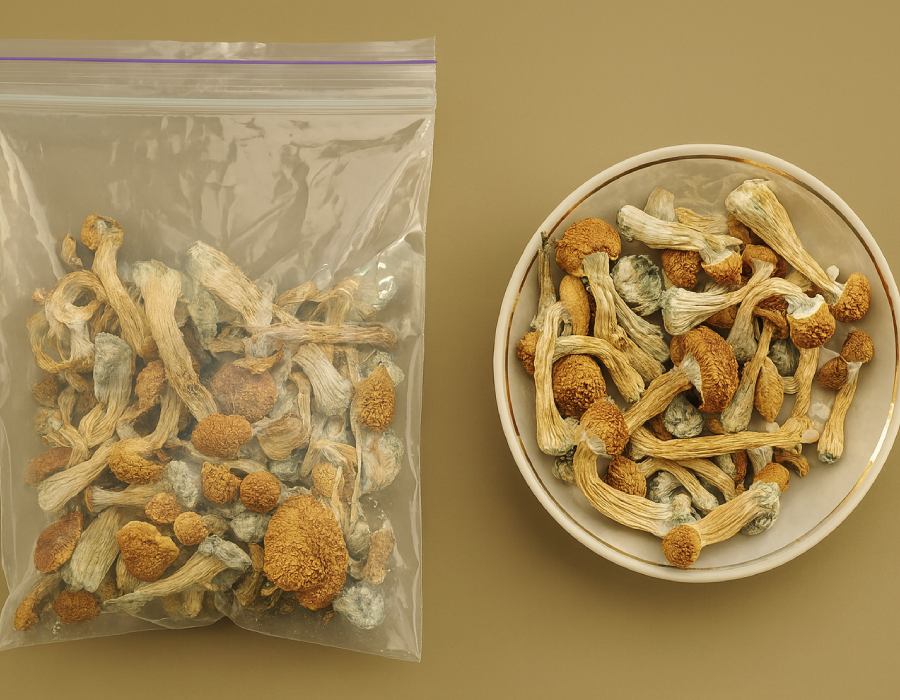
Golden Teacher generally resembles what many people imagine when they think of a classic Psilocybe cubensis mushroom. Mature specimens often develop broad, golden-brown caps supported by relatively slender stems. During sporulation, the cap typically opens more fully, revealing dark purple-brown spores beneath.
Penis Envy, by contrast, is immediately recognizable because of its unusual morphology.
Instead of expanding into a wide umbrella-shaped cap, many Penis Envy mushrooms remain compact, developing thick stems and comparatively small caps. Many cultivated examples also produce few or no spores, making them visually distinct from more typical cubensis varieties.
These differences are interesting—but appearance alone tells us very little about how a mushroom will affect an individual.
Large mushrooms are not necessarily stronger than small ones.
Dense mushrooms are not automatically more potent.
Visual characteristics can sometimes correlate with particular genetics, but they do not reliably predict the concentration of psychoactive compounds inside a specific mushroom.
Why Penis Envy Developed Its Reputation
Few mushroom varieties have generated as much discussion as Penis Envy.
Unlike Golden Teacher, whose reputation developed around introspection and philosophy, Penis Envy became famous because experienced cultivators repeatedly described stronger subjective effects from comparatively small amounts.
Over time, this reputation spread through cultivation communities, online forums, books, and educational websites.
Eventually, researchers began asking an important question:
Was this simply community folklore, or could measurable chemical differences explain these reports?
Recent analytical studies have helped answer part of that question.
Laboratory testing has shown that some Penis Envy samples contain relatively high concentrations of psilocybin and psilocin compared with many other cultivated Psilocybe cubensis varieties.
However, this finding comes with an equally important qualification.
Not every Penis Envy sample demonstrates identical chemistry.
Natural biological variation remains substantial.
One grow may produce mushrooms with noticeably different concentrations than another, even when both carry the same variety name.
That is why laboratory measurements always provide more reliable information than variety names alone.
Golden Teacher’s Reputation Was Built Differently
Golden Teacher became popular for almost the opposite reason.
Rather than being promoted primarily for potency, it became associated with experiences described as:
- reflective
- emotionally open
- balanced
- philosophical
- gentle
- introspective
These descriptions appear frequently throughout decades of community discussions.
Importantly, they reflect subjective reports rather than conclusions established through controlled scientific comparisons.
Modern research has not demonstrated that Golden Teacher consistently produces one psychological profile while Penis Envy produces another.
Instead, these reputations have largely developed through accumulated user experiences.
That distinction matters because culture often influences expectations—and expectations themselves may shape psychedelic experiences.
The Role of Expectation
Imagine two people entering identical experiences.
The first has spent weeks reading that Penis Envy is “overwhelming.”
The second believes Golden Teacher is “gentle.”
Before either mushroom has produced noticeable effects, each person already carries expectations.
Psychologists have long recognized that expectations influence perception across many areas of medicine.
Researchers refer to this broadly as expectancy effects.
Psychedelic experiences appear no different.
Expectation may influence:
- attention
- interpretation
- emotional responses
- perceived intensity
- memory formation
This does not mean expectation creates the experience.
Rather, it becomes one variable interacting with many others.
Someone expecting an overwhelming journey may become more attentive to early bodily sensations.
Someone anticipating calm introspection may notice reflective thoughts more readily.
Neither expectation determines the outcome—but both may shape how it is experienced and remembered.
Genetics Explain More Than Marketing
One of the biggest misconceptions surrounding psilocybin mushrooms involves the word strain.
Strictly speaking, mushrooms are not classified into “strains” in the same way cannabis commonly is.
Most products marketed under names such as:
- Golden Teacher
- Penis Envy
- B+
- Mazatapec
- Albino A+
- Blue Meanie (cubensis)
represent cultivated varieties or genetic lineages rather than formally recognized botanical strains.
Over years of cultivation, growers selectively propagated mushrooms displaying desirable characteristics.
These included:
- growth rate
- appearance
- fruit size
- resilience
- sporulation
- chemical tendencies
This process resembles selective breeding more than strict species differentiation.
All of these varieties remain members of the same species:
Psilocybe cubensis.
Why Every Harvest Is Slightly Different
Even genetically similar mushrooms do not develop under identical conditions.
Their chemistry may be influenced by factors including:
- substrate composition
- temperature
- humidity
- air exchange
- harvest timing
- drying techniques
- storage conditions
Researchers continue investigating exactly how these variables affect alkaloid production.
Current evidence suggests considerable natural variation remains unavoidable.
This explains why experienced cultivators often avoid making absolute potency claims.
Instead, they speak about probabilities rather than guarantees.
What Laboratory Testing Actually Measures
Modern analytical laboratories typically examine several compounds within psilocybin mushrooms.
The best known include:
- psilocybin
- psilocin
- baeocystin
- norbaeocystin
Scientists continue studying whether compounds beyond psilocybin contribute meaningfully to subjective experiences.
Current evidence remains limited.
Most available research still considers psilocybin and psilocin the primary psychoactive compounds.
Importantly, laboratory testing measures chemistry—not psychology.
A laboratory cannot measure:
- personal insight
- emotional healing
- mystical significance
- creativity
- self-understanding
Those experiences emerge through the interaction between chemistry and human psychology.
More Potent Does Not Mean More Therapeutic
One misconception deserves careful correction.
People often assume stronger mushrooms automatically produce better therapeutic outcomes.
Current psychedelic research does not support this conclusion.
Clinical studies investigating psilocybin-assisted therapy emphasize many variables besides dosage.
Researchers carefully consider:
- preparation
- therapeutic relationship
- psychological support
- integration
- participant screening
- clinical environment
The medicine represents only one component of a much larger therapeutic process.
Researchers at Johns Hopkins University repeatedly emphasize that supportive preparation and integration contribute significantly to psychedelic-assisted therapy.
Why Clinical Research Uses Pure Psilocybin
Readers often wonder why major universities do not simply use cultivated mushrooms.
The answer involves scientific consistency.
Clinical trials aim to reduce unnecessary variables.
Using pharmaceutical-grade psilocybin allows researchers to know precisely:
- compound purity
- dosage
- stability
- manufacturing standards
Whole mushrooms naturally contain varying concentrations of multiple compounds.
That variability makes standardized research considerably more difficult.
This does not mean whole mushrooms are scientifically unimportant.
Rather, standardized compounds help researchers isolate specific variables during clinical investigation.
Why Personal Biology Matters
Two individuals may consume mushrooms containing nearly identical chemistry while reporting remarkably different experiences.
Researchers increasingly recognize the importance of individual biology.
Factors currently under investigation include:
- serotonin receptor variation
- metabolism
- body composition
- hormonal influences
- liver enzyme activity
- nervous system sensitivity
Scientists have not discovered a single biological explanation for psychedelic variability.
Instead, multiple systems appear to interact simultaneously.
This helps explain why identical mushrooms do not produce identical experiences.
Set and Setting Still Matter
No discussion of Penis Envy vs Golden Teacher would be complete without acknowledging one of psychedelic science’s most influential concepts:
set and setting.
“Set” generally refers to internal conditions including:
- mindset
- emotional state
- expectations
- personality
- intentions
“Setting” refers to external factors including:
- environment
- comfort
- privacy
- trusted company
- music
- perceived safety
Current clinical research consistently incorporates these principles because researchers recognize their influence on subjective outcomes.
A more potent mushroom cannot compensate for an unsuitable environment.
Likewise, thoughtful preparation may significantly influence how someone responds to unexpected emotions regardless of variety.
Community Reputation Versus Scientific Evidence
One challenge facing anyone researching psychedelic mushrooms is separating folklore from evidence.
Community reports remain valuable.
They often identify patterns worth investigating.
However, anecdotal reports cannot establish scientific certainty.
For example:
Thousands of individuals may describe Penis Envy as producing stronger experiences.
That observation helped motivate laboratory analysis.
Laboratory research then investigated whether measurable chemical differences existed.
This process illustrates how community knowledge and scientific investigation can complement each other—provided one is not mistaken for the other.
Responsible education distinguishes between:
What people commonly report
and
What controlled evidence currently demonstrates.
Which Variety Is Better?
Perhaps the most common question receives the least satisfying answer.
Neither variety is objectively “better.”
Each has developed a reputation shaped by:
- cultivation history
- community experience
- laboratory chemistry
- cultural storytelling
Ultimately, the question becomes less about superiority and more about understanding.
Knowing why these mushrooms are discussed differently allows readers to move beyond simplistic rankings toward a more informed appreciation of psychedelic science.
Part 3 of 3
Penis Envy vs Golden Teacher: A Complete Guide to Potency, Effects, and the Right Mushroom for You
Primary Focus Keyword: Penis Envy vs Golden Teacher
Common Myths About Penis Envy and Golden Teacher
As psychedelic education becomes more mainstream, so do misconceptions.
Many of these myths originate from repeated online discussions rather than scientific evidence. While community experience can provide useful observations, it should not replace careful interpretation of research.
Let’s examine some of the most common misunderstandings.
Myth 1: Penis Envy Is Always Twice as Strong
This is probably the most repeated statement on the internet.
The reality is more nuanced.
Analytical testing has shown that some Penis Envy samples contain relatively high concentrations of psilocybin and psilocin compared with many other Psilocybe cubensis varieties. However, natural variation exists between individual mushrooms, cultivation methods, harvests, and storage conditions.
A mushroom’s name alone cannot accurately predict its exact chemical composition.
In other words, laboratory analysis—not reputation—is the only reliable way to determine potency.
Myth 2: Golden Teacher Is Only for Beginners
Golden Teacher is often introduced as the “beginner’s mushroom.”
While many people appreciate its long-standing reputation within the psychedelic community, this label can become misleading.
There is no scientific evidence demonstrating that Golden Teacher consistently produces simpler or easier psychological experiences than every other Psilocybe cubensis variety.
People with extensive psychedelic experience continue to choose Golden Teacher, not because it is considered “weak,” but because meaningful experiences cannot be reduced to potency alone.
Reflection, emotional insight, curiosity, and psychological depth are not measured by chemical concentration.
Myth 3: Stronger Mushrooms Produce Better Experiences
This assumption appears surprisingly often.
Current psychedelic research suggests that the quality of an experience depends on far more than potency.
Researchers studying psilocybin-assisted therapy consistently emphasize variables such as:
- Psychological preparation
- Therapeutic support
- Expectations
- Emotional readiness
- Integration
- Environment
Increasing potency does not automatically increase insight.
Likewise, a less intense experience should never be viewed as less meaningful.
Sometimes the most valuable experiences are quiet, reflective, and gradual rather than emotionally overwhelming.
Myth 4: Mushroom Variety Determines the Experience
One of the biggest misconceptions surrounding Penis Envy vs Golden Teacher is that each variety produces a fixed psychological profile.
In reality, subjective experiences emerge through a combination of factors including:
- Biology
- Environment
- Previous life experiences
- Expectations
- Physical health
- Sleep
- Stress
- Personality
- Current emotional state
Current scientific literature does not support the idea that every person consuming Golden Teacher experiences philosophical introspection while every Penis Envy experience becomes intensely visual or mystical.
These reputations have largely developed through community storytelling rather than controlled comparative trials.
The Future of Psilocybin Research
Research into psilocybin has accelerated dramatically over the past decade.
Universities and healthcare institutions continue exploring potential therapeutic applications while also investigating fundamental questions about how psychedelic experiences occur.
Areas receiving increasing attention include:
- Individual biological differences
- Brain connectivity
- Psychological flexibility
- Emotional processing
- Neuroplasticity
- Therapeutic mechanisms
- Long-term outcomes
- Personalized treatment approaches
Rather than asking which mushroom variety is “best,” researchers increasingly focus on understanding why individuals respond differently to similar psychedelic experiences.
This shift reflects a broader movement toward personalized medicine.
Future research may eventually help explain how genetics, metabolism, personality, and environmental factors interact to shape psychedelic experiences.
Responsible Decision-Making Begins With Education
Whether someone is researching Penis Envy, Golden Teacher, or psilocybin more generally, education should come before assumptions.
Responsible learning includes understanding:
- Current scientific evidence
- Research limitations
- Potential psychological risks
- Individual variability
- The importance of preparation
- Why expectations matter
- The value of integration afterward
No article can predict how a particular individual will respond to a psychedelic experience.
Anyone considering psychedelic use should approach the topic thoughtfully and be aware that psilocybin may not be appropriate for everyone, particularly individuals with certain medical or psychiatric conditions.
The National Center for Complementary and Integrative Health (NCCIH) provides evidence-based information on current psilocybin research, safety considerations, and what remains unknown:
Frequently Asked Questions
Is Penis Envy scientifically proven to be stronger than Golden Teacher?
Some laboratory analyses have found relatively high concentrations of psilocybin and psilocin in certain Penis Envy samples compared with many other Psilocybe cubensis varieties. However, natural variation means potency cannot be determined by variety name alone.
Are Penis Envy and Golden Teacher different mushroom species?
No.
Both belong to the same species:
Psilocybe cubensis.
They are cultivated varieties with different physical characteristics and cultivation histories rather than separate species.
Does Golden Teacher always produce a gentler experience?
Not necessarily.
Although Golden Teacher has developed a community reputation for balanced, reflective experiences, current scientific evidence does not demonstrate that it consistently produces a particular psychological profile across all individuals.
Why do two people have different experiences with the same mushrooms?
Researchers believe multiple variables contribute, including:
- Genetics
- Metabolism
- Personality
- Expectations
- Emotional state
- Environment
- Previous psychedelic experience
- Physical health
- Sleep quality
These interacting factors help explain why psychedelic experiences vary so widely between individuals.
Does potency determine therapeutic value?
Current research suggests no.
Clinical studies emphasize preparation, professional support, integration, and therapeutic context rather than maximizing potency.
A more intense experience is not automatically more beneficial.
Key Takeaways
Comparing Penis Envy vs Golden Teacher is about much more than asking which mushroom is stronger.
Current evidence suggests:
- Both belong to Psilocybe cubensis.
- Penis Envy has earned a reputation for relatively high potency, supported by analyses of some samples, but substantial natural variation remains.
- Golden Teacher’s reputation is rooted primarily in decades of community experience rather than controlled scientific comparisons.
- Individual biology, mindset, preparation, and environment all contribute significantly to subjective psychedelic experiences.
- Laboratory analysis provides more reliable information than variety names alone.
- Potency should never be confused with therapeutic value or personal significance.
Understanding these distinctions helps replace myths with evidence and encourages a more balanced conversation around psychedelic education.
Continue Learning
If you’re exploring psilocybin from an educational perspective, you may also find these guides helpful:
Building a deeper understanding of these topics provides important context beyond simply comparing mushroom varieties.
Conclusion
The discussion surrounding Penis Envy vs Golden Teacher often begins with potency, but it should not end there.
Both varieties belong to the same species, yet each has developed a distinct reputation through years of cultivation, community experience, and, more recently, scientific investigation. While laboratory studies suggest that some Penis Envy samples contain relatively high concentrations of psychoactive compounds, chemistry alone cannot explain the full complexity of a psychedelic experience.
Every journey reflects an interaction between the mushroom and the person. Biology, emotional state, expectations, environment, prior experiences, physical health, and countless other variables all contribute to how psilocybin is perceived and remembered. That complexity is precisely why no single variety can guarantee a particular outcome.
As psychedelic science continues to evolve, the most valuable approach is one grounded in curiosity, critical thinking, and respect for evidence. Understanding the limits of current research is just as important as understanding its discoveries. Rather than asking which mushroom is objectively “better,” a more meaningful question is how scientific knowledge, thoughtful preparation, and responsible education can help people develop realistic expectations about psychedelic experiences.
At PorciniMushrooms.eu, our goal is to support informed decision-making through evidence-based education. We believe that replacing myths with reliable information helps create a more responsible conversation around psilocybin—one that values research, transparency, and individual understanding over exaggerated claims or simplistic comparisons.